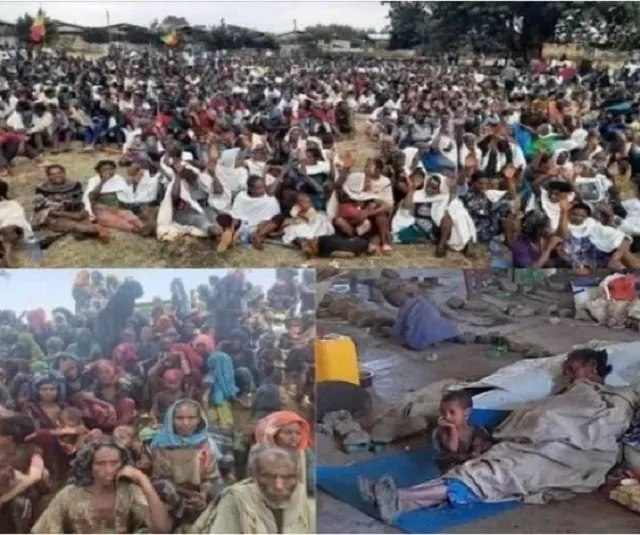
Is What Is Happening to the Amhara People a Genocide? – Borkena Media

This article was first published by Borkena Media and is republished here for informational purposes only.
What “Genocide” Means Under International Law
Genocide is not a rhetorical term. It is a crime defined in binding international law. The 1948 United Nations Convention on the Prevention and Punishment of the Crime of Genocide, adopted in the aftermath of the Holocaust, written so humanity would never again have to say “we didn’t know”, defines genocide as acts committed with intent to destroy, in whole or in part, a national, ethnical, racial, or religious group. Those acts include killing members of the group, causing serious bodily or mental harm, deliberately inflicting conditions of life calculated to bring about physical destruction, imposing measures to prevent births, and forcibly transferring children.
The decisive legal element is intent, not isolated atrocities, but a pattern of actions that demonstrates a deliberate aim to destroy a group as such. When that pattern is examined against the documented record in Ethiopia’s Amhara region, the conclusion is not ambiguous. It is devastating.
Who Are the Amhara?
The Amhara are one of Ethiopia’s oldest and most deeply rooted peoples, comprising more than one-third of the country’s entire population. They are farmers, educators, clergy, traders, mothers, and children. Amharic, their language, is Ethiopia’s federal working language, the lingua franca that holds the country together. They are mostly Orthodox Christians who have carved churches into the faces of mountains and preserved a civilization across millennia.
Since the early 1990s, following the adoption of an ethnic-federalist political system engineered by the Tigrayan People’s Liberation Front, the Amhara were progressively branded in official and semi-official narratives as historical “oppressors.” That label, embedded into the architecture of the state itself, laid the ideological groundwork for everything that followed. Genocide does not begin with bullets. It begins with words. And the words came first.
Patterns of Violence: A Systematic Campaign
In April 2023, Prime Minister Abiy Ahmed, the same man handed a Nobel Peace Prize in 2019, ordered the dissolution of the Amhara Special Forces and FANO, the only two security apparatuses standing between millions of Amhara civilians and the armed groups targeting them. Stripped of their protection, an entire people were left deliberately defenseless. What followed was not chaos. It was a campaign.
According to the UN Office of the High Commissioner for Human Rights, hundreds of thousands of civilians were killed in security operations in Amhara, alongside mass arbitrary detentions, extrajudicial executions, and deliberate attacks on civilian infrastructure. The European Council on Foreign Relations documented that drone strikes have repeatedly hit residential neighborhoods, markets, schools, and health facilities, locations with no evident military necessity. On January 29–30, 2024, Ethiopian National Defense Forces carried out summary executions in the town of Merawi: Amnesty International, corroborated by satellite imagery and survivor testimony, confirmed that dozens of civilians were rounded up from their homes and shot. This was not a battlefield incident. It was a deliberate killing.
Millions of Amhara have been forcibly displaced. More than seven million children are out of school, not because of poverty, but because their schools were bombed. Over eleven million people face acute humanitarian catastrophe. The systematic destruction of crops, water sources, hospitals, and markets is not collateral damage. It is the deliberate dismantling of the conditions necessary for a people’s existence, which the Genocide Convention explicitly recognizes as a genocidal act.
Rape as a Weapon of Genocide
Perhaps the most chilling evidence of genocidal intent is what is being done to Amhara women and girls. When rape is deployed systematically by an armed force, it is not a crime of opportunity, it is a crime of strategy. It is a weapon designed to destroy a people not only today, but across generations.
A BBC investigation documented 2,700 rape cases at just 43 health facilities, only 4% of those in the Amhara region, between July 2023 and May 2025. Over half of survivors tested positive for STIs, with victims aged 8 to 65. Extrapolated region-wide, the true number of survivors likely exceeds 50,000, with most cases identifying Ethiopian army soldiers as perpetrators in federally controlled urban areas, pointing to systematic violence.
Ethiopia’s own Ethiopian Human Rights Commission acknowledged evidence of sexual and gender-based violence committed by government security forces in the Amhara region. A landmark 2025 report by Physicians for Human Rights documented systematic rape, sexual torture, and reproductive violence targeting Amhara women and girls, including gang rape by armed personnel, assaults accompanied by ethnic slurs, and attacks explicitly aimed at preventing victims from bearing children. Healthcare workers reported that survivors described perpetrators declaring their intent to end their people’s biological future.
Under international law, this is not merely a war crime. When rape is deployed with the declared intent to destroy a group’s reproductive capacity, the Rome Statute and the Genocide Convention both recognise it as a genocidal act. The soldiers told their victims what they were doing, and why. The law has a name for it.
The Experts Have Already Spoken
The Lemkin Institute for Genocide Prevention issued a Red Flag Alert for Ethiopia in April 2023 and escalated it to an Active Genocide Alert for the Amhara region in September 2023. These are not political statements. Dr. Gregory Stanton, who developed the Ten Stages of Genocide framework, a model that successfully predicted the Rwandan genocide five years before it occurred, has stated publicly and unequivocally that genocide is happening in Ethiopia targeting the Amhara people. Genocide Watch has placed Ethiopia simultaneously at Stage 6 (Polarization), Stage 8 (Persecution), Stage 9 (Extermination), and Stage 10 (Denial).
These institutions do not issue alerts casually. Their entire mandates exist to identify genocidal processes before mass destruction becomes irreversible. When the architect of the world’s most trusted genocide early-warning system names a genocide, the burden of proof has been met. The silence of the international community in the face of these warnings is not neutrality. It is complicity.
The Verdict
The documented record establishes a clearly identifiable ethnic group; decades of political dehumanization embedded in the state; the deliberate removal of the group’s only protective security forces; large-scale civilian killings and mass detention; targeted destruction of schools, healthcare, and livelihoods; systematic sexual violence with explicit reproductive intent; forced displacement on a massive scale; and state denial, information blackouts, and obstruction of independent investigation. These elements align precisely with the legal definition of genocide and with every recognized stage of the genocidal process.
History shows that genocide is rarely acknowledged while it is happening. Recognition usually comes later, after the graves have been counted and the survivors are too few to speak. The Amhara people are not waiting for a courtroom verdict. They are dying. The law says this is genocide. The framework says this is genocide. The world’s foremost genocide prevention experts say this is genocide. The survivors, those still alive to speak, are telling us this is genocide.
The unresolved question is no longer whether sufficient warning signs exist. It is whether the world will act on them or repeat the familiar words uttered after every preventable atrocity: “Never again.”
Sources: UN OHCHR • Amnesty International • Human Rights Watch • Physicians for Human Rights • The Lemkin Institute for Genocide Prevention • Genocide Watch • Ethiopian Human Rights Commission • European Council on Foreign Relations • UN Genocide Convention (1948)